
The AI-Mind project has come to a close
After five years of collaborative research, the AI-Mind project, funded by Horizon 2020, came to an end in February 2026. Bringing together 17 partners across 8 European countries, the project set out to develop artificial intelligence (AI) tools for screening brain connectivity and dementia risk estimation. These tools ultimately aim to support healthcare professionals in their diagnosis and enable them to predict which people with Mild Cognitive Impairment (MCI) will eventually develop dementia.
The value of AI in dementia prevention
More than 10 million Europeans show signs of MCI, a condition defined by deficits in memory but not severe enough to significantly impact activities of daily life. However, MCI is associated with a high risk of developing dementia, with around 50% of people progressing to dementia within five years. The patient’s journey towards a conclusive dementia diagnosis often takes many years, involving inefficient clinical follow-ups.
The vision behind AI-Mind was to shorten the patient journey through a digital solution capable of providing fast and highly accurate (>95%) individual dementia risk predictions. At a time when AI is transforming the health sector, the project demonstrates how AI can reshape the way dementia is detected, opening new possibilities for personalised care and improved patient outcomes.

By leveraging AI, the project aims to enable clinicians to carry out early, population-based screening assessments for people with MCI. One of the most innovative aspects of AI-Mind is the integration of electroencephalography (EEG) with magnetoencephalography (MEG), both of which provide non-invasive measures of electrical activity in the brain with millisecond temporal resolution. AI-Mind researchers collected a broad range of prospective data from participants with MCI, consisting of demographic, neuropsychological, genetic, blood biomarkers and M/EEG data.
Progress and achievements
The AI-Mind study has been at the heart of the project. Launched in January 2022, the study recruited more than 1,000 participants with MCI across four countries: Finland, Italy, Norway and Spain. This milestone reflects the efforts of clinical teams involved in recruitment and data collection, whose work enabled the creation of a unique and highly valuable dataset. All data were securely uploaded to a central server in Norway, ensuring high standards of data privacy, security and integrity.
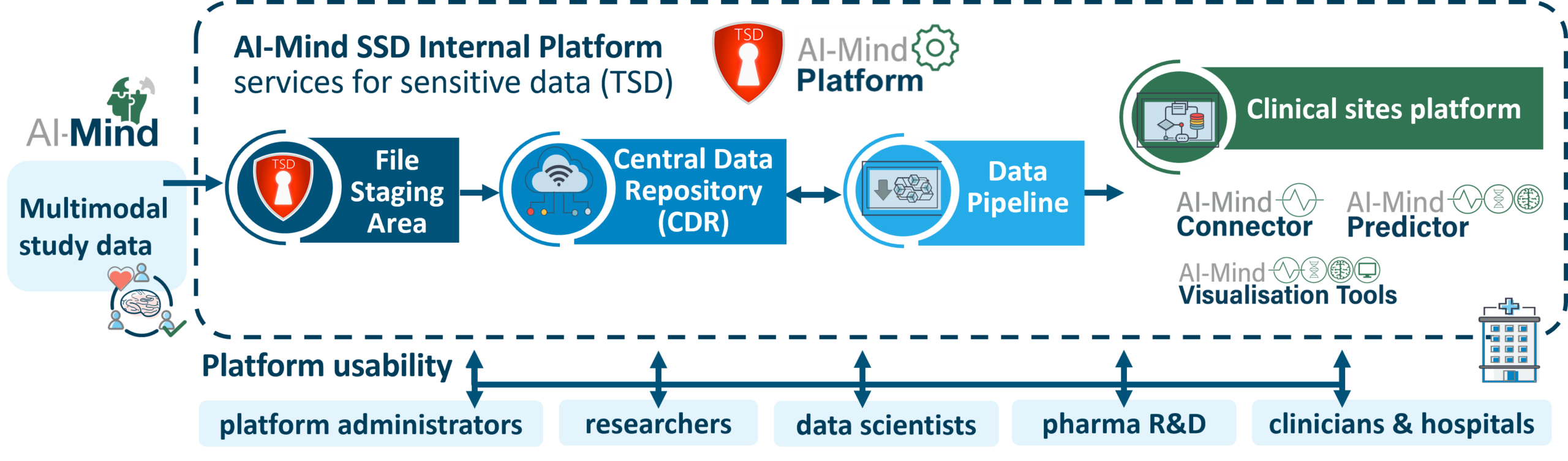
This dataset has played a crucial role in developing and validating the AI-Mind tools: the AI-Mind Connector and the AI-Mind Predictor. These two complementary tools form the core of the AI-Mind approach to early dementia risk assessment. The AI-Mind Connector focuses on identifying dysfunctional brain networks, while the AI-Mind Predictor assesses the risk of dementia by analysing data from the Connector, enriched with information collected through the clinical study (i.e. cognitive tests, genetic biomarkers).

In recent months, both tools have been successfully integrated into a trustworthy platform, designed to assist clinicians in analysing complete datasets and identifying patterns to assess the risk of dementia in people with MCI. This platform has undergone a continuous maintenance and refinement process, including bug fixing, performance optimisation, and the improvement of several key functionalities. The development and testing of the Connector and Predictor prototypes rely on advanced probabilistic machine learning and deep learning approaches, ensuring robust and scalable performance. Their integration into the EBRAINS research infrastructure further strengthens AI-Mind’s position within the emerging European Health Data Space ecosystem.
In parallel, consortium members have supported the uptake of these innovative tools by developing practical resources, such as a glossary and guidelines on innovative practices. These are available via AI-Mind Share, a space designed to share valuable insights from the AI-Mind project and our research. It provides open-access resources aimed at clinicians, researchers, healthcare professionals, patient organisations and other stakeholders. AI-Mind has also contributed to shaping the policy and implementation landscape. Towards the end of the project, partners produced three policy briefs tailored to specific stakeholder groups. Among them, the brief “Transforming Dementia Care” was launched during the Lunch Debate hosted at the European Parliament in Brussels.
Looking ahead

Although the AI-Mind project has formally concluded, its impact will continue well beyond its lifetime. The tools, datasets and clinical insights generated provide a strong foundation for future research and pave the way for integration into healthcare systems. Building on these achievements, new initiatives are already exploring how to scale up and refine AI-based approaches for dementia prevention.
A few words from Ira Haraldsen, the project coordinator.
What is a personal highlight of the project for you?
Over the past five years, AI-Mind has brought together experts from across Europe to tackle one of the biggest challenges in dementia research. Throughout the project, we have made significant strides in developing innovative AI-based tools to support healthcare professionals in diagnosis and enable more timely interventions for patients. A personal highlight for me has been seeing how this progress has been driven by close collaboration between researchers and clinical experts, all working towards a shared vision of AI-enabled brain health solutions. The strength of this collaboration has allowed us to generate high-quality data, develop robust tools, and ensure that our results are meaningful in a real-world clinical context.
What comes next after AI-Mind?
What we have achieved so far is just the beginning. We are laying the foundation for a future where AI-driven insights will support more personalised and effective interventions, ultimately improving outcomes for people at risk of dementia. The next steps will focus on leveraging the data generated within AI-Mind in new projects, as well as further validation and continued development of the tools. At the same time, it will be important to explore how these solutions can be integrated into healthcare systems, ensuring they effectively support clinicians in their daily practice and contribute to improved patient outcomes.