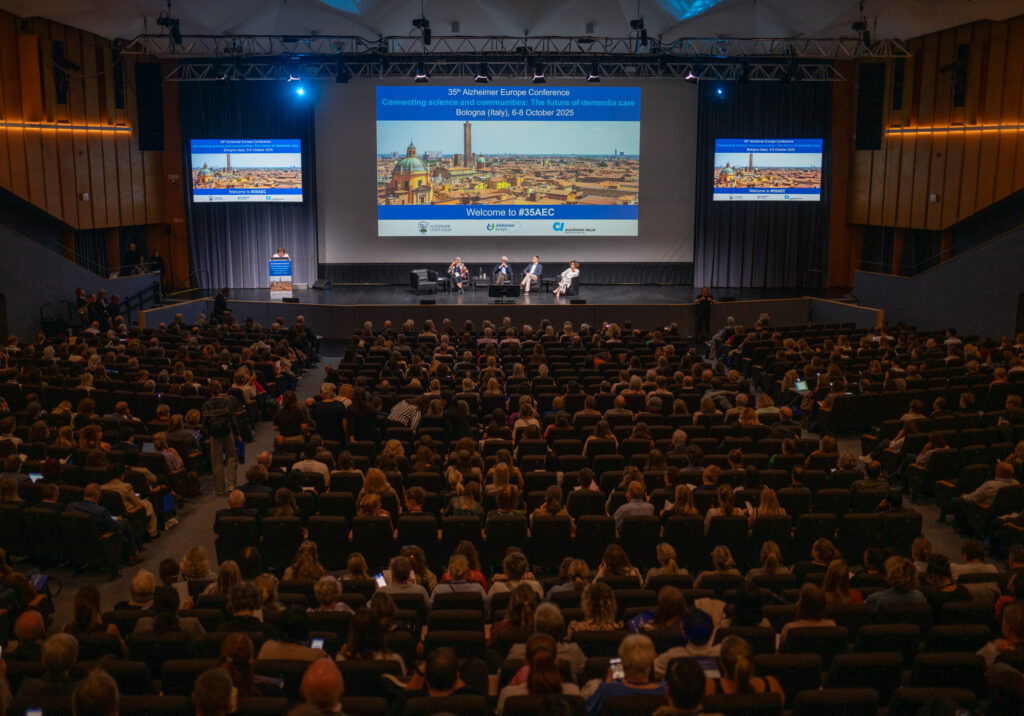
From 6 to 8 October 2025, the 35th Alzheimer Europe Conference (#35AEC) brought together over 1,500 delegates from 48 countries in Bologna (Italy) under the banner “Connecting Science and Communities: The Future of Dementia Care”.
The conference provided a unique networking opportunity for people with dementia, their carers, Alzheimer’s Association volunteers and staff, health and social care professionals, researchers, academics and representatives from industries across Europe and beyond.
Voices at the forefront
The conference opened with a joint plenary by the European Working Group of People with Dementia (EWGPWD) and the European Dementia Carers Working Group (EDCWG). Drawing on their lived experience, speakers called for dementia to be prioritised in research and policy.
Kevin Quaid, Chair of the EWGPWD, expressed in his speech that, “we have to use this conference to make real change and make this world a little bit safer for us. The voices of people with dementia, regardless of the type or the stage, and of the people and families who care for or support us, matter the most”.
Later, keynote speaker Marco Trabucchi (Italy) focused on the future of diagnosis and treatment. He urged optimism in innovation, stating that patients “do not need pessimism” but rather a “strong, generous engagement by researchers, doctors and psychosocial operators to improve the quality of their life, overcoming enormous amounts of interfering events.”
Featured AI-Mind session

The AI-Mind consortium was proud to host a dedicated session on 8 October titled “AI-Mind at the Finnish Line: Advancing Trustworthy and Scalable Clinical AI for Early Dementia Risk Detection,” chaired by Dr. Ira Haraldsen. Presentations by AI-Mind members explored the project’s key outcomes, challenges and the roadmap ahead. A recording of the session will soon be available on the AI-Mind YouTube channel: https://www.youtube.com/@AIMind_eu/.
The AI-Mind project aims to develop novel Artificial Intelligence (AI)-based tools for screening brain connectivity and estimating dementia risk, ultimately supporting healthcare professionals in providing accurate diagnoses and timely interventions for patients.
The session featured four speakers:
- Christoffer Hatlestad-Hall (Oslo University Hospital, Norway) shared key figures and clinical implementation insights.
- Lukas Gemein (Oslo University Hospital, Norway) demonstrated how AI can be integrated into cognitive healthcare workflows and discussed practical challenges and opportunities.
- Tim Govers (The Radboud University Medical Center, the Netherlands) addressed heath economic impact of AI-powered medical tools.
- Guido Giuffrè (Università Cattolica del Sacro Cuore, Italy) provided insights from a real-world clinical adoption of AI-Mind solutions.


In the discussion, we engaged on important topics such as early health technology assessment (HTA), an area of particular importance if we want these innovations to be scalable and sustainable in real health systems. In her closing remarks, Dr. Haraldsen highlighted the project’s final phase focus on implementation, underscoring the vital role of public–private partnerships like AI-Mind in advancing trustworthy AI in healthcare.
Outreach

The AI-Mind consortium was proud to host a dedicated session on 8 October titled “AI-Mind at the Finnish Line: Advancing Trustworthy and Scalable Clinical AI for Early Dementia Risk Detection,” chaired by Dr. Ira Haraldsen. Presentations by AI-Mind members explored the project’s key outcomes, challenges and the roadmap ahead. A recording of the session will soon be available on the AI-Mind YouTube channel: https://www.youtube.com/@AIMind_eu/.